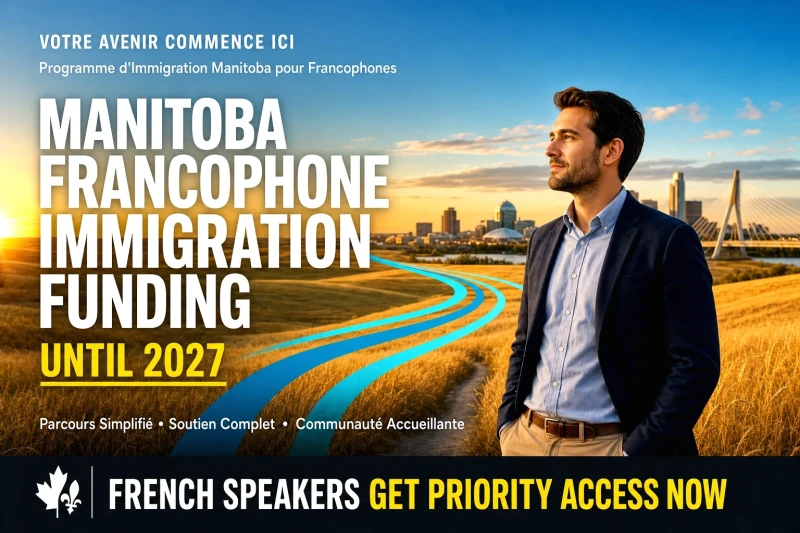
Manitoba's Economic Development Council partners with federal and provincial governments to attract French-speaking immigrants, addressing labour shortages while revitalizing Francophone minority communities
On This Page You Will Find:
- $1.3 million federal investment details – How Manitoba plans to use these funds to attract French-speaking immigrants
- Extended student pilot program – Why the Francophone Minority Communities Student Pilot now runs through August 2027
- Digital solutions and recognition support – Innovative tools streamlining the immigration process for bilingual candidates
- Partnership framework – How federal and provincial governments collaborate with Manitoba's Economic Development Council
- Success metrics and future impact – What 8.9% Francophone admission rates mean for community growth
Summary:
Manitoba's Francophone communities are getting a significant boost with a $1.3 million federal investment announced July 6, 2026. This funding targets innovative promotional initiatives, digital immigration solutions, and skills recognition support specifically designed for French-speaking and bilingual candidates. The announcement coincides with a one-year extension of the Francophone Minority Communities Student Pilot through August 2027, keeping pathways open for international students who strengthen Manitoba's French-language communities. With 515 Francophone students already in Canada under the pilot program and the first graduates eligible for permanent residence in 2027, this initiative addresses both labour shortages and the demographic challenges facing Francophone minority communities across Manitoba.
🔑 Key Takeaways:
- $1.3 million investment supports Manitoba's Francophone immigration through digital solutions, promotional campaigns, and skills recognition programs
- Student pilot extended to August 2027 – Francophone Minority Communities Student Pilot continues attracting French-speaking international students
- 515 students already participating with 150 family members, first graduates eligible for permanent residence in 2027
- 8.9% Francophone admission rate achieved for permanent residents outside Quebec in 2025, showing progress toward federal targets
- Partnership approach combines federal funding with Manitoba's Economic Development Council for Manitoba's Bilingual Municipalities
Why This Investment Matters Now
If you're a French-speaking professional considering Canada, or you're part of a Manitoba community wondering how to reverse decades of demographic decline, this announcement represents more than just another government press release.
Francophone minority communities outside Quebec face a critical challenge: maintaining linguistic and cultural vitality while addressing severe labour shortages. Manitoba's solution? A coordinated federal-provincial strategy that makes it easier for French-speaking immigrants to navigate the system, get their credentials recognized, and contribute immediately to the economy.
The timing couldn't be better. With the first cohort of Francophone Minority Communities Student Pilot participants graduating in 2027, Manitoba is creating a pipeline of French-speaking talent that addresses both economic and demographic needs simultaneously.
Breaking Down the $1.3 Million Investment
The federal government isn't just throwing money at the problem—this investment targets specific bottlenecks in the Francophone immigration process.
What the Funding Covers
| Investment Area | Purpose | Expected Impact |
|---|---|---|
| Digital Solutions | Streamline application processes for Francophone candidates | Faster processing, reduced administrative barriers |
| Promotional Initiatives | Targeted marketing to French-speaking talent worldwide | Increased awareness of Manitoba opportunities |
| Skills Recognition Support | Faster credential assessment for foreign qualifications | Reduced underemployment, quicker workforce integration |
| Targeted Research | Identify labour market needs in Francophone communities | Better matching of candidates to opportunities |
The Economic Development Council for Manitoba's Bilingual Municipalities will implement these initiatives. This isn't a generic immigration program adapted for French speakers—it's purpose-built for the unique needs of Manitoba's Francophone communities.
Why Skills Recognition Matters
Here's something most people don't realize: a French-speaking engineer from Cameroon or a teacher from Morocco often faces months of credential assessment delays before they can work in their field. This investment specifically addresses that gap.
By the time you're reading this, the digital solutions should already be reducing wait times. That means if you're a bilingual professional with credentials from a Francophone country, your pathway to working in Manitoba just got significantly shorter.
The Francophone Minority Communities Student Pilot Extension
The extension of the Francophone Minority Communities Student Pilot (FMCSP) through August 2027 is arguably more significant than the dollar amount suggests.
How the Pilot Works
The FMCSP creates a unique pathway for Francophone students from regions with historically high study permit refusal rates. Here's what makes it different:
Standard International Student Process:
- Apply to designated learning institution
- Apply for study permit (higher rejection rates for certain countries)
- Limited settlement support
- No guaranteed pathway to permanent residence
FMCSP Process:
- Apply to participating designated learning institution
- Selection through pilot program (addresses historical rejection bias)
- Settlement and integration services throughout studies
- Clear pathway to permanent residence after graduation
- Family members can accompany students
The Numbers Tell the Story
| Metric | Current Status | Significance |
|---|---|---|
| Students arrived | 515 | Building critical mass in Francophone communities |
| Family members | 150 | Strengthening community demographic base |
| First graduates eligible for PR | 2027 | Proof-of-concept year for retention strategy |
| Program extension | Through August 2027 | Additional cohorts can enter pipeline |
What this means: by 2027, Manitoba will have concrete data on whether this approach successfully converts international students into permanent residents who strengthen Francophone communities. The extension ensures the pipeline doesn't dry up while those results come in.
Understanding the Broader Federal Strategy
This Manitoba investment fits within a much larger federal commitment to Francophone immigration outside Quebec.
Federal Investment Framework
| Program Component | Investment Amount | Timeframe | Purpose |
|---|---|---|---|
| Centre for Innovation in Francophone Immigration | $25 million | 5 years (2023-2028) | Coordinate Francophone immigration initiatives nationally |
| Projects funded to date | $15.7 million | Ongoing | 20 projects supporting recruitment and community support |
| Manitoba project | $1.3 million | Current announcement | Digital solutions and skills recognition |
The federal government set an ambitious target: increase Francophone immigration outside Quebec substantially. In 2025, they achieved an 8.9% admission rate for French-speaking permanent residents outside Quebec—a significant milestone.
What 8.9% Actually Means
That percentage might not sound impressive until you understand the baseline. Francophone immigration outside Quebec has historically lagged far behind demographic needs. An 8.9% rate represents hundreds of additional French-speaking permanent residents compared to previous years.
For Manitoba specifically, this translates to families settling in communities like Saint-Boniface, strengthening institutions, supporting French-language schools, and creating the critical mass needed for cultural vitality.
How This Affects You: Practical Pathways
Whether you're a potential immigrant, a Manitoba employer, or a community organization, here's what these changes mean practically.
For French-Speaking Professionals
If you're considering Manitoba immigration:
- Express Entry remains your primary pathway – The federal Express Entry system continues to be the main route for skilled workers
- Provincial Nominee Program (PNP) advantages – Manitoba's PNP may offer additional points or streams for Francophone candidates
- Skills recognition support – The new investment means faster credential assessment for your foreign qualifications
- Digital tools coming online – Expect streamlined application processes specifically designed for Francophone applicants
Timeline expectations:
- Skills assessment: Previously 4-6 months, potentially reduced to 2-3 months with new support
- Settlement services: Available from arrival, not after you've struggled for months
- Community integration: Connection to Francophone networks from day one
For International Students
If you're a Francophone student from a region with historically high refusal rates:
The FMCSP extension through August 2027 gives you a viable pathway that addresses systemic barriers. Here's what you need to know:
Participating designated learning institutions offer programs that qualify for the pilot. You'll need to check the current list on the Immigration, Refugees and Citizenship Canada (IRCC) website, as institutions can be added.
What you get:
- Higher acceptance rates compared to standard International Student Program (ISP)
- Settlement and integration services throughout your studies
- Clear pathway to permanent residence after graduation
- Ability to bring immediate family members
The catch: You must genuinely commit to studying in Manitoba and contributing to Francophone minority communities. This isn't a backdoor to Toronto or Vancouver—it's a pathway for those who want to build their lives in Manitoba's French-speaking communities.
For Manitoba Employers
If you're struggling to fill positions and open to bilingual candidates:
This investment directly addresses your labour shortage challenges. The partnership with the Economic Development Council for Manitoba's Bilingual Municipalities means:
- Targeted recruitment in Francophone regions matching your industry needs
- Faster credential recognition reducing the time before foreign-trained professionals can work
- Settlement support increasing retention rates for newcomers
- Bilingual talent pool offering advantages for businesses serving diverse markets
Action step: Connect with the Economic Development Council for Manitoba's Bilingual Municipalities to understand how to access this talent pipeline.
The Partnership Model That Makes This Work
What makes this announcement different from typical immigration initiatives is the partnership structure.
Three-Level Collaboration
| Partner | Role | Contribution |
|---|---|---|
| Immigration, Refugees and Citizenship Canada (IRCC) | Federal oversight and funding | $1.3 million investment, policy framework, national coordination |
| Government of Manitoba | Provincial implementation | Labour market needs assessment, credential recognition, integration with provincial programs |
| Economic Development Council for Manitoba's Bilingual Municipalities | On-the-ground delivery | Direct connection to Francophone communities, local employer relationships, settlement support |
This isn't Ottawa dictating policy or Manitoba working in isolation. The Economic Development Council brings intimate knowledge of which communities need workers, which employers are ready to hire, and which settlement services actually work.
Why This Model Succeeds Where Others Fail
Generic immigration programs often fail because they don't account for local realities. A program that works for Toronto's tech sector doesn't necessarily work for Manitoba's agricultural communities or manufacturing sector.
By involving the Economic Development Council for Manitoba's Bilingual Municipalities from the beginning, this initiative ensures:
- Labour market matching – Immigrants arrive with skills Manitoba actually needs
- Community readiness – Francophone communities have capacity to welcome and integrate newcomers
- Realistic expectations – Both immigrants and communities understand what to expect
- Sustained support – Settlement services continue beyond the initial arrival period
What Happens Next: Timeline and Milestones
Understanding the timeline helps you plan whether you're an applicant, employer, or community stakeholder.
Key Dates and Milestones
| Timeframe | Milestone | Significance |
|---|---|---|
| July 2026 | Funding announcement and FMCSP extension | Program certainty through August 2027 |
| Late 2026 | Digital solutions rollout | Streamlined application processes go live |
| 2027 | First FMCSP graduates eligible for PR | Proof of concept for student-to-resident pathway |
| August 2027 | Current FMCSP extension expires | Evaluation point for program continuation |
| 2023-2028 | Action Plan for Official Languages timeline | Broader federal commitment to Francophone immigration |
What to watch for in 2027: The first FMCSP participants graduating and applying for permanent residence will provide crucial data. High retention rates will likely lead to program expansion; low rates will trigger program redesign.
Political Context Matters
This investment falls under the Action Plan for Official Languages 2023–2028, which commits $25 million over five years to the Centre for Innovation in Francophone Immigration. With 20 projects funded so far (totaling $15.7 million), there's still approximately $9.3 million available for future initiatives.
The political reality: Francophone immigration outside Quebec has bipartisan support because it addresses both official languages commitments and economic needs. Regardless of which party governs federally, these programs are likely to continue in some form.
Common Questions and Misconceptions
"Does this mean I need to speak perfect French to immigrate to Manitoba?"
No. The programs target Francophone and bilingual candidates. If you speak French and English, you're actually more attractive to employers. Even strong French with developing English qualifies you for many pathways.
"I'm not from a traditionally Francophone country—can I still benefit?"
Absolutely. If you're a French speaker from anywhere in the world, these pathways are open to you. The FMCSP specifically targets regions with high refusal rates, but the broader immigration support applies to all Francophone candidates.
"Will these students actually stay in Manitoba?"
That's the million-dollar question (or $1.3 million question, in this case). The program design includes settlement services and community integration specifically to improve retention. We'll know more definitively in 2027 when the first cohort becomes eligible for permanent residence.
"How is this different from Quebec's immigration programs?"
Quebec has constitutional authority over its own immigration selection. These programs target Francophone minority communities outside Quebec—places where French speakers are the minority and face unique challenges maintaining their language and culture.
The Bigger Picture: Why Canada Needs This
Step back from the policy details for a moment. Why does the federal government care so much about Francophone immigration outside Quebec?
Three Converging Pressures
1. Constitutional and political obligations: Canada is officially bilingual. When Francophone minority communities decline demographically, it threatens that fundamental aspect of Canadian identity.
2. Economic imperatives: Manitoba (like most provinces) faces severe labour shortages. French-speaking immigrants often bring multilingual skills valuable in international business.
3. Community sustainability: Without demographic renewal, Francophone institutions—schools, cultural centers, media—become unsustainable. Immigration offers the fastest path to demographic stabilization.
What Success Looks Like in 5 Years
If this initiative succeeds, here's what Manitoba's Francophone communities will look like by 2031:
- French-language schools with growing enrollment, not declining
- Businesses confident they can hire bilingual talent when needed
- Cultural institutions with audiences to sustain programming
- Young families choosing to stay because communities are vibrant
- Economic growth in Francophone regions matching or exceeding provincial averages
That's the vision driving this investment. Whether it becomes reality depends on execution, which is why the partnership model matters so much.
Taking Action: Next Steps for Different Audiences
If You're a Potential Immigrant
Immediate actions:
- Visit the IRCC Francophone immigration page to understand current pathways
- Check your eligibility for Express Entry and Manitoba's Provincial Nominee Program
- Begin credential assessment process early—don't wait until you're ready to apply
- Research participating designated learning institutions if you're considering the student pathway
- Connect with the Economic Development Council for Manitoba's Bilingual Municipalities to understand community opportunities
Timeline planning:
- Start credential assessment: 6-12 months before intended immigration
- Language testing: 3-6 months before application
- Application preparation: 2-3 months
- Processing times: Variable, but digital solutions should reduce wait times
If You're a Manitoba Employer
Immediate actions:
- Contact the Economic Development Council for Manitoba's Bilingual Municipalities about accessing Francophone talent pipelines
- Review your credential recognition practices—are you creating unnecessary barriers for foreign-trained professionals?
- Develop settlement support for new hires—housing assistance, community connections, and language support improve retention
- Consider bilingual workplace policies that use immigrants' language skills
If You're a Community Organization
Immediate actions:
- Understand how the $1.3 million investment will be deployed in your region
- Partner with the Economic Development Council for Manitoba's Bilingual Municipalities on settlement services
- Develop welcome programs specifically for Francophone newcomers
- Create mentorship opportunities connecting established residents with newcomers
The Bottom Line
Manitoba's $1.3 million investment in Francophone immigration represents more than funding—it's a coordinated strategy addressing demographic decline, labour shortages, and community vitality simultaneously.
For French-speaking professionals worldwide, this creates clearer pathways to Canadian immigration with built-in support systems. For Manitoba employers, it means access to bilingual talent addressing critical labour needs. For Francophone minority communities, it offers hope for demographic renewal and cultural sustainability.
The extension of the Francophone Minority Communities Student Pilot through August 2027 ensures the pipeline remains open while the first cohort proves the concept. By 2027, we'll have concrete evidence of whether this approach successfully converts international students into permanent residents who strengthen Manitoba's French-speaking communities.
The partnership between Immigration, Refugees and Citizenship Canada, the Government of Manitoba, and the Economic Development Council for Manitoba's Bilingual Municipalities provides the structure needed for success. Unlike top-down programs that ignore local realities, this collaboration ensures labour market needs, community capacity, and immigrant support align.
Whether you're a potential immigrant evaluating options, an employer struggling with vacancies, or a community leader concerned about demographic trends, these initiatives create opportunities that didn't exist before. The question isn't whether these programs matter—it's whether stakeholders will use them effectively.
The federal government has committed $25 million over five years to Francophone immigration innovation. Manitoba's $1.3 million is one piece of that larger puzzle. As other provinces watch these results, successful models will likely expand while unsuccessful approaches get redesigned.
For anyone connected to Francophone immigration in Manitoba, 2027 will be a pivotal year. The first FMCSP graduates will apply for permanent residence, providing crucial retention data. The digital solutions and skills recognition support funded by this investment will have been operational long enough to evaluate effectiveness. And the broader question—can targeted investment reverse decades of demographic decline in Francophone minority communities—will begin to be answered.
The tools are now in place. The funding is committed. The partnerships are established. What happens next depends on execution and the willingness of all stakeholders—governments, employers, communities, and immigrants themselves—to make this vision a reality.
