
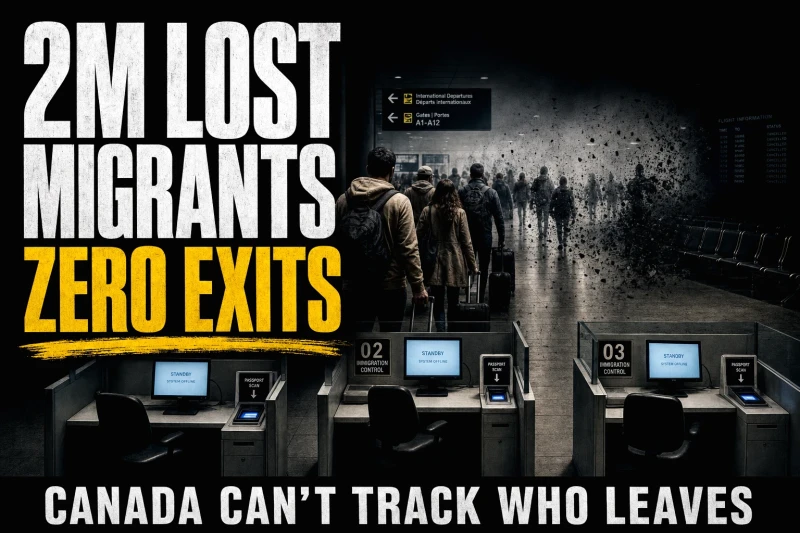
Immigration officials acknowledge they're "flying in the dark" on tracking temporary visa holders, sparking urgent calls for system overhaul and tighter controls
On This Page You Will Find:
- Breaking revelations about Canada's shocking lack of exit tracking for 2.1 million temporary residents
- Exclusive details on the government's emergency pilot program to regain control
- Expert recommendations from Canada's top immigration council on fixing the broken system
- Specific targets and timelines for reducing temporary populations through 2028
- Actionable insights on what these changes mean for students, workers, and employers
Summary:
Canada's immigration system is operating without critical visibility into millions of temporary residents. With 632,000 study permit holders and 1.5 million temporary workers currently in the country, Immigration, Refugees and Citizenship Canada (IRCC) has admitted they're "flying in the dark" with no reliable tracking of who leaves when their visas expire. The C.D. Howe Institute's immigration targets council—chaired by experts including former immigration minister Jason Kenney—has issued urgent recommendations for deeper cuts, better data collection, and clearer pathways for high-skilled workers. As the government races to implement exit tracking by late 2026 and reduce temporary residents to under 5% of the population by 2027, these changes will fundamentally reshape Canada's immigration landscape for students, workers, and employers alike.
🔑 Key Takeaways:
- Canada currently has no reliable system to track when 2.1 million temporary residents actually leave the country after visas expire
- IRCC launched an emergency pilot program in May 2026 to contact international students with expiring visas and develop exit tracking by year-end
- The government aims to reduce temporary residents from current levels to under 5% of Canada's total population by the end of 2027
- New admission targets drop to 385,000 temporary residents in 2026 and 370,000 in 2027-2028—a significant reduction from previous years
- High-skilled temporary workers will get clearer pathways to permanent residency based on objective criteria like earnings, while low-skilled programs face cuts
The Moment Canada Realized It Lost Control
Picture this: You're running a massive apartment building with 2.1 million temporary tenants. You know when people move in, but you have absolutely no idea when—or if—they move out. You just assume they'll leave when their lease expires. That's basically how Canada has been managing its temporary resident population.
In August 2026, Parisa Mahboubi, chair of the C.D. Howe Institute's immigration targets council, put it bluntly: Canada is "flying in the dark." And she wasn't exaggerating.
The revelation sent shockwaves through policy circles. Here's a country that prides itself on orderly immigration management, yet it had no clear data on visa renewals, no reliable tracking of departures, and was essentially operating on the honor system—hoping people would leave when their legal status expired.
If you've ever wondered why Canada suddenly pumped the brakes on temporary immigration in 2024, this is your answer. The system wasn't just overwhelmed—it was fundamentally broken at the most basic level of accountability.
The Numbers That Sparked an Emergency Response
Let's talk specifics, because the scale of this tracking gap is staggering.
As of June 30, 2026, Canada was hosting:
| Category | Number of People | What This Means |
|---|---|---|
| Study permit holders | 632,000 | International students actively enrolled or authorized to study |
| Temporary work permit holders | 1,500,000 | Foreign workers employed across all sectors and skill levels |
| Total temporary residents | 2,132,000 | Combined population larger than the entire province of Saskatchewan |
To put this in perspective, that's roughly 5.4% of Canada's total population living on temporary status. And here's the kicker—the government had no reliable way to confirm how many of these people actually left when their permits expired.
Deputy Immigration Minister Ted Gallivan's admission was particularly damning: IRCC "didn't have a game plan or even an intention to manage the departure of people at the expiration of their visa." They simply hadn't taken responsibility for tracking exits, even in collaboration with the Canada Border Services Agency (CBSA).
Think about what that means for housing markets, healthcare capacity planning, infrastructure development, and labor market forecasting. Every level of government and countless businesses were making decisions based on incomplete data.
Why This Tracking Gap Happened (And Why It Matters to You)
You might be wondering: How does a G7 country end up with such a massive blind spot?
The answer lies in Canada's historical approach to immigration management. For decades, the system was designed around permanent immigration—people who came to stay. The infrastructure, data systems, and enforcement mechanisms were all built for that reality.
But starting in the 2010s, temporary immigration exploded. International students became a massive revenue source for colleges and universities (we're talking billions of dollars annually). The Temporary Foreign Worker Program expanded dramatically to fill labor shortages. Post-graduation work permits created a pipeline from study to work.
The problem? The tracking systems never evolved to match this new reality.
Canada Border Services Agency knew when people entered the country (obviously—you go through customs). But exits? If you're driving across the land border to the United States, there's no formal Canadian exit process. If you're flying out, airlines share passenger manifests, but matching that data to immigration status in real-time was never systematically implemented.
The result was a system that could tell you how many temporary resident visas were issued, but couldn't reliably tell you how many people were actually in the country at any given moment, or who had overstayed their authorization.
The Government's Emergency Fix: Exit Tracking Pilot Program
Faced with this crisis of accountability, Immigration Minister Lena Diab announced a multi-pronged response in May 2026.
Here's what's actually happening right now:
Phase 1: Proactive Outreach to Expiring Visa Holders
Starting in May 2026, IRCC began directly contacting international students whose study permits were approaching expiration. This isn't just a courtesy reminder—it's the government's first systematic attempt to create a paper trail of who should be leaving and when.
If you're an international student in Canada right now, expect to receive communication from IRCC 90 days before your permit expires, then again at 60 days and 30 days. The message will outline your options: extend your status, apply for a post-graduation work permit, transition to permanent residency if eligible, or prepare to leave Canada.
Phase 2: Integrated Exit Data Collection
This is the technical heavy lifting. IRCC and CBSA are collaborating to create an integrated system that:
- Records all air departures through airline passenger manifest sharing
- Captures land border exits through U.S. entry data sharing (when you enter the U.S., Canada now considers you exited)
- Matches exit records to immigration status in near-real-time
- Flags discrepancies for enforcement follow-up
The target date for full implementation? By the end of 2026.
Phase 3: Status Recording and Compliance Monitoring
Since May 2026, IRCC has been recording whether temporary residents are actively in Canada or have departed. This creates a living database that can inform everything from immigration levels planning to resource allocation for settlement services.
The practical impact? If you're a temporary resident who leaves Canada, the government will now know. And if you don't leave when your status expires, they'll know that too—and enforcement actions become far more likely.
What Canada's Top Immigration Experts Are Demanding
The C.D. Howe Institute's immigration targets council isn't just any advisory group. Chaired by Parisa Mahboubi and including former immigration minister Jason Kenney alongside top academics, this is the brain trust that shapes immigration policy thinking.
Their August 2026 submission pulled no punches. Here's what they're pushing for:
Recommendation 1: Maintain the 5% Population Cap Through 2027
The council wants the government to hold firm on limiting temporary residents to 5% of Canada's total population throughout 2026, with a comprehensive review scheduled for early 2027.
What this means in practice: With Canada's population at approximately 42 million, that's a hard cap of about 2.1 million temporary residents. Given that we're already at that level, this effectively means zero net growth in temporary populations—every new arrival must be offset by a departure.
For prospective international students and workers, this creates unprecedented competition for limited spots.
Recommendation 2: Track Economic Contributions, Not Just Bodies
Here's where it gets interesting. The council isn't just calling for better data on who's here—they want detailed tracking of what temporary residents contribute economically.
This includes:
- Tax revenues generated
- Consumer spending impacts
- Job creation (yes, temporary residents also create jobs)
- Innovation and entrepreneurship metrics
- Sector-specific labor market impacts
Why does this matter? Because right now, policy decisions are being made based on incomplete cost-benefit analysis. If temporary residents contribute more economically than previously understood, that changes the optimal policy mix. If they contribute less in certain categories, that also informs decision-making.
Recommendation 3: Create Clear Pathways for High-Skilled Workers
This is the most consequential recommendation for temporary workers currently in Canada.
The council explicitly stated that the optimal temporary resident balance requires "clear pathways for temporary residents employed in high-skill occupations to transition to permanent residency, using objective criteria such as earnings."
Translation: If you're a high-earning temporary worker, Canada wants to keep you. If you're in a low-skill, low-wage position, your pathway to permanence just got much harder.
The council suggested using earnings as an objective threshold. While specific numbers weren't provided, this could mean something like: "Temporary workers earning above $70,000 annually get priority processing for permanent residency applications."
This represents a fundamental philosophical shift—from "temporary worker" as a distinct category to "temporary worker" as an extended audition period for the highest performers.
Recommendation 4: Comprehensive System Reforms
The council's reform package includes:
For International Students:
- Stronger admission standards (expect higher language requirements, more rigorous financial proof)
- Better alignment between study programs and labor market needs
- Tighter regulation of designated learning institutions
For Temporary Workers:
- Scaling back the Temporary Foreign Worker Program, particularly for low-skilled positions
- Reducing reliance on temporary labor in sectors that should be developing domestic workforce
- Stricter Labor Market Impact Assessment requirements
For Permanent Immigration:
- Simplifying pathways through Express Entry
- Reducing processing times for high-skilled applicants
- Better integration between temporary and permanent streams
The Government's Official Targets: What's Actually Changing
Prime Minister Mark Carney's government has committed to specific, measurable targets. Here's the roadmap:
Temporary Resident Admission Targets
| Year | New Temporary Resident Admissions | Change from Previous Policy |
|---|---|---|
| 2026 | 385,000 | Significant reduction (approximately 30% below 2024 levels) |
| 2027 | 370,000 | Further 15,000 reduction |
| 2028 | 370,000 | Maintained at 2027 levels |
These numbers represent new admissions, not total population. With the 5% population cap, this means the government is banking on significant numbers of current temporary residents departing.
Permanent Resident Targets and Economic Immigration Shift
| Year | Total Permanent Residents | Economic Immigration Share |
|---|---|---|
| 2026 | 380,000 | 59% (224,200 people) |
| 2027 | 380,000 | 62% (235,600 people) |
| 2028 | 380,000 | 64% (243,200 people) |
Notice what's happening here: Total permanent immigration stays flat, but the composition shifts dramatically toward economic migrants. By 2028, nearly two-thirds of all new permanent residents will come through economic programs like Express Entry, Provincial Nominee Program (PNP), and business immigration streams.
For family class and humanitarian immigration, this means proportionally fewer spots—a controversial trade-off that prioritizes economic outcomes over family reunification.
What This Means for You: Practical Implications by Category
If You're Currently an International Student
The landscape just got significantly more competitive and regulated. Here's what you need to know:
Before Your Permit Expires:
- Expect multiple communications from IRCC starting 90 days before expiration
- Your options will be clearly outlined: extend, transition to work permit, apply for permanent residency, or leave
- Ignoring these communications is no longer a viable strategy—enforcement will follow
For Post-Graduation Plans:
- Post-graduation work permits remain available, but expect scrutiny on program quality and labor market alignment
- Your pathway to permanent residency increasingly depends on moving into high-skilled, well-paid employment
- Geographic location matters more than ever—provinces with stronger labor market needs offer better PR pathways
Pro Tip: If you're currently studying in a program with questionable labor market outcomes, consider whether additional credentials in high-demand fields might strengthen your permanent residency prospects.
If You're a Temporary Foreign Worker
Your future in Canada now depends heavily on your skill level and earnings.
High-Skilled Workers (Professional, Managerial, Technical roles):
- You're in the driver's seat—Canada wants to retain you
- Expect streamlined pathways to permanent residency if you meet earnings thresholds
- Focus on documenting your economic contribution: tax returns, salary progression, specialized skills
Low-Skilled Workers (Hospitality, Agriculture, General Labor):
- The Temporary Foreign Worker Program is contracting in these sectors
- Pathways to permanent residency are narrowing significantly
- Consider whether transitioning to higher-skilled roles is possible before your permit expires
Critical Reality Check: The government is explicitly trying to reduce reliance on temporary low-skilled workers. If you're in this category, don't assume permit renewals will continue indefinitely.
If You're an Employer Relying on Temporary Foreign Workers
The regulatory environment is tightening substantially. Here's what's coming:
Expect Stricter Labor Market Impact Assessments:
- More rigorous proof that no Canadian workers are available
- Higher wage requirements to match or exceed median wages
- Shorter approval periods requiring more frequent renewals
Strategic Workforce Planning Required:
- Start developing domestic workforce pipelines now
- Consider whether automation or process improvements can reduce labor needs
- For truly essential foreign workers, prioritize those who could transition to permanent residency
The Bottom Line: The era of treating temporary foreign workers as a convenient, renewable labor source is ending. The government wants employers to either develop domestic workers or transition valuable foreign workers to permanent status.
If You're Considering Coming to Canada
Timing and pathway selection matter more than ever.
For Prospective Students:
- Apply to programs with clear labor market outcomes in high-demand fields
- Prioritize institutions with strong post-graduation employment rates
- Budget for the full journey: study + post-graduation work + permanent residency transition
- Understand that admission standards are rising—prepare stronger applications
For Prospective Workers:
- Target roles that qualify for Express Entry before arriving on temporary permits
- Research Provincial Nominee Programs that align with your occupation
- Consider whether your intended occupation meets the emerging high-skill, high-earning threshold
- Be realistic about low-skilled positions—they're increasingly dead-ends for permanent residency
Critical Timing Note: The 2026-2028 period represents a contraction phase. If you're on the fence about coming to Canada, earlier is likely better than later, as admission standards and competition will only intensify.
The Bigger Picture: Why Canada Made This U-Turn
It's worth understanding the political and social context that drove these dramatic changes.
Between 2015 and 2024, Canada's temporary resident population more than doubled. The growth was particularly explosive among international students, with some provinces seeing their post-secondary enrollments become majority-foreign.
The consequences became impossible to ignore:
Housing Crisis Amplification: Purpose-built student housing couldn't keep pace, pushing international students into rental markets and contributing to skyrocketing rents in cities like Toronto, Vancouver, and Montreal.
Healthcare System Strain: Temporary residents use healthcare services but weren't factored into capacity planning, contributing to longer wait times and physician shortages.
Social Services Pressure: From employment services to language training, systems designed for permanent immigration volumes buckled under temporary resident demand.
Labor Market Distortions: Some sectors became dependent on temporary foreign workers, reducing incentives to improve wages, working conditions, or productivity.
Public Opinion Shift: By 2024, polling showed Canadians increasingly concerned about immigration levels—a dramatic shift in a country that historically supported high immigration.
Prime Minister Carney's July 2026 statement that immigration was "too high" when he took office in 2025 marked a watershed moment. Blaming the previous government for losing control of international students and temporary workers, he pledged his administration had "taken back control."
Whether you view this as necessary course correction or reactionary overcorrection depends on your perspective. But the political reality is clear: the pendulum has swung decisively toward restriction and control.
What Happens Next: Timeline of Key Milestones
Here's what to watch for as this unfolds:
By End of 2026:
- Full implementation of exit tracking system (IRCC + CBSA integration)
- First comprehensive data on temporary resident departures vs. arrivals
- Initial enforcement actions against visa overstayers using new tracking capabilities
Early 2027:
- C.D. Howe Institute council review of 5% population cap effectiveness
- Possible adjustment to targets based on economic impact data
- Government decision on whether to maintain, tighten, or slightly loosen restrictions
Throughout 2027:
- Continued reduction toward under 5% temporary resident population target
- Implementation of strengthened admission standards for international students
- Rollout of clearer high-skilled worker permanent residency pathways
2028 and Beyond:
- New equilibrium with temporary residents under 5% of population
- Economic immigration comprising 64% of permanent resident admissions
- Potentially new frameworks for managing temporary-to-permanent transitions
The Uncomfortable Questions Nobody's Answering Yet
As with any major policy shift, there are significant uncertainties and potential unintended consequences:
Will reducing temporary residents actually improve housing affordability? The evidence is mixed—housing supply is the fundamental issue, and reducing demand without increasing supply may have limited impact.
What happens to colleges and universities that became financially dependent on international student tuition? Some institutions could face serious financial pressure, potentially leading to program cuts or even closures.
Are there enough high-skilled permanent resident applicants to fill the increased economic immigration targets? If not, the system could face different bottlenecks.
How will enforcement actually work for visa overstayers? Canada has limited immigration detention capacity and faces legal constraints on removal—tracking is one thing, but actual enforcement is another.
Will this create a two-tier system where only wealthy international students can afford to come? Higher admission standards and financial requirements could reduce diversity and accessibility.
These questions don't have easy answers, and the next few years will reveal whether this policy recalibration achieves its intended goals or creates new problems.
Your Action Plan: What to Do Right Now
Depending on your situation, here are concrete steps to take:
If you're a current temporary resident:
- Check your permit expiration date immediately
- Document your economic contributions (tax returns, employment records, earnings progression)
- Research permanent residency pathways relevant to your situation
- Respond promptly to any IRCC communications
- Consult with a licensed immigration consultant or lawyer if your situation is complex
If you're planning to come to Canada:
- Research programs and pathways with highest permanent residency conversion rates
- Ensure your intended occupation aligns with high-demand, high-skill categories
- Prepare the strongest possible application—competition is intensifying
- Have a realistic timeline and budget for the full immigration journey
- Consider provincial programs, not just federal pathways
If you're an employer:
- Audit your current temporary foreign worker reliance
- Develop domestic workforce recruitment and training strategies
- Identify key foreign workers who should be supported for permanent residency
- Prepare for stricter Labor Market Impact Assessment requirements
- Build relationships with immigration consultants who understand the new landscape
The Bottom Line: A New Era of Immigration Management
Canada's admission that it was "flying in the dark" on temporary resident tracking represents more than just a data problem—it's a fundamental acknowledgment that the country's immigration management capacity was overwhelmed by explosive growth it didn't anticipate and couldn't control.
The response—dramatic reductions in temporary resident admissions, emergency implementation of exit tracking, and a philosophical shift toward economic immigration—will reshape Canadian immigration for years to come.
For the 2.1 million temporary residents currently in Canada, this creates both challenges and opportunities. The pathway to permanent residency is narrowing for low-skilled workers but potentially widening for high-skilled, high-earning professionals. The days of indefinite temporary status renewals are ending, forcing everyone to make clear decisions about their future.
For Canada, the question is whether this recalibration will achieve the intended goals of reducing pressure on housing and services while maintaining the economic benefits of immigration. The answer will depend on execution—something that hasn't been this government's strong suit in immigration management.
What's certain is this: if you're navigating Canada's immigration system as a temporary resident, employer, or prospective immigrant, the rules of the game have fundamentally changed. The era of "figure it out as you go" is over. The era of "clear pathways with high bars" has begun.
Your success in this new landscape depends on understanding these changes early, making strategic decisions based on the new reality, and taking action before the window of opportunity narrows further.
