
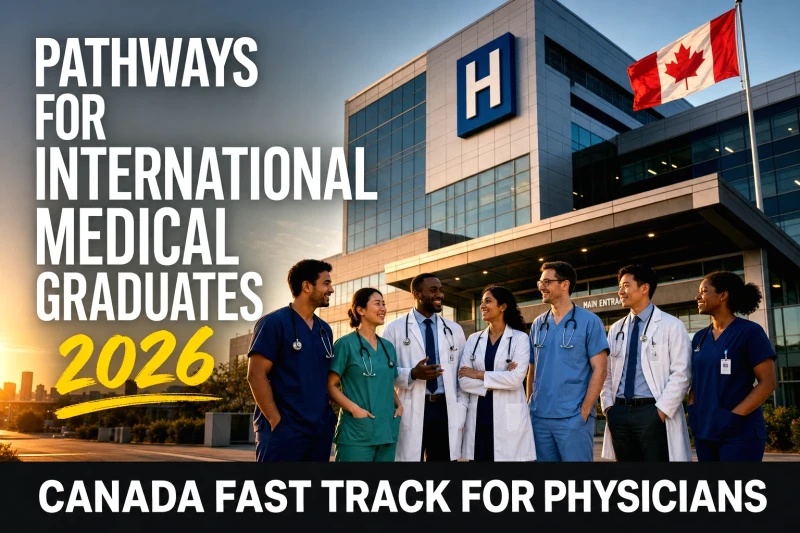
Healthcare professionals now have dedicated pathways to permanent residence with unprecedented processing speeds and guaranteed provincial nomination spots
On This Page You Will Find:
- The game-changing Express Entry category launching in 2026 that cuts physician immigration time in half
- 5,000 guaranteed provincial nomination spots reserved exclusively for licensed doctors
- Province-by-province breakdown of the fastest pathways to permanent residence
- The surprising specialties Canada needs most (hint: it's not what you think)
- Step-by-step action plan to position yourself for the new streamlined process
Summary:
Dr. Maria Santos from the Philippines stared at her rejection letter in disbelief. After three years of navigating Canada's complex immigration system, she was starting to lose hope of ever practicing medicine in Canada. But if Maria were applying today, her story would be completely different. Canada just announced the most significant overhaul to physician immigration in decades – a dedicated Express Entry category for doctors launching in 2026, plus 5,000 guaranteed provincial nomination spots with 14-day work permit processing. For the first time, Canada is rolling out the red carpet specifically for international physicians, and the opportunities are staggering.
🔑 Key Takeaways:
- New physician-only Express Entry category launches early 2026 with just 1 year Canadian experience required
- 5,000 additional provincial nomination spots reserved exclusively for doctors with job offers
- Work permits now processed in just 14 days for nominated physicians
- Family medicine, surgery, and clinical specialties are priority occupations
- Some provinces allow applications without job offers if you can bill their health insurance
Picture this: You're a qualified physician working anywhere in the world, watching Canada's healthcare crisis unfold on the news. Emergency rooms closing, family doctors retiring faster than new ones can be trained, and rural communities desperately seeking medical professionals. What if I told you that Canada has just created the most physician-friendly immigration system in its history?
The timing couldn't be more perfect. While other countries tighten their immigration policies, Canada is doing the exact opposite for healthcare professionals. They're not just opening doors – they're removing them entirely.
The Revolutionary 2026 Express Entry Category for Physicians
Here's what makes this announcement absolutely innovative: For the first time in Canadian immigration history, doctors get their own dedicated Express Entry category. No more competing against software engineers, accountants, or other skilled workers. This is exclusively for physicians.
The requirements are surprisingly achievable:
- Minimum one year of Canadian work experience within the past three years
- That's it. No complex point calculations or hoping your score is high enough
Think about what this means. If you can secure even a temporary position, fellowship, or residency placement in Canada for just 12 months, you're eligible for this fast-track to permanent residence. The invitations begin in early 2026, giving you roughly 12-18 months to position yourself strategically.
The eligible specialties cover virtually every medical field:
Family Medicine & General Practice – This remains Canada's #1 priority. Rural communities are offering signing bonuses up to $200,000 plus loan forgiveness programs.
Surgical Specialties – Cardiac surgeons, neurosurgeons, orthopedic surgeons, and general surgeons are in critical demand. Some provinces are fast-tracking licensing for experienced surgeons.
Clinical & Laboratory Medicine – The scope is massive: cardiologists, dermatologists, emergency physicians, oncologists, radiologists, anesthesiologists, and dozens more specialties.
What's particularly exciting is that this isn't just another immigration program with limited spots. The government has committed to making this a permanent fixture of their immigration system, recognizing that healthcare shortages aren't going away anytime soon.
The Game-Changing Provincial Nominee Enhancement
But wait – there's more. Canada has reserved 5,000 federal admission spaces specifically for provinces to nominate licensed doctors. These spots are in addition to regular Provincial Nominee Program quotas, meaning healthcare professionals aren't taking spots away from other immigrants.
Here's the part that will blow your mind: Nominated doctors receive work permits in just 14 days.
Let me put this in perspective. The standard work permit processing time ranges from 12-20 weeks. For nominated physicians, it's 14 days. You could literally receive your nomination on a Monday and be working in a Canadian hospital by the following Monday.
This isn't just about speed – it's about eliminating the financial stress and career uncertainty that has deterred so many qualified physicians from choosing Canada.
Province-by-Province Opportunities: Where You Should Focus
Not all provinces are created equal when it comes to physician immigration. Here's your strategic breakdown:
Nova Scotia: The Hidden Gem
Nova Scotia has quietly become one of the most physician-friendly provinces in Canada. Their Physician Stream is a non-Express Entry pathway, meaning you don't need to worry about point calculations or competing scores.
What makes Nova Scotia special:
- Direct pathway for GPs, family physicians, and specialists
- Requires approval from Nova Scotia Health Authority (not as scary as it sounds)
- The province has been aggressively recruiting international physicians
- Lower cost of living compared to Ontario or British Columbia
- Beautiful coastal lifestyle with four distinct seasons
The Healthcare Professionals Immigration Pilot offers even more flexibility, providing pathways through both the Nova Scotia Nominee Program and the Atlantic Immigration Program.
Ontario: The Powerhouse with Unique Advantages
Ontario processes more physician immigrants than any other province, and for good reason. The Ontario Immigrant Nominee Program includes something no other province offers: pathways where licensed physicians can apply without job offers.
Here's the catch (and it's a good one): You need to be eligible to bill the Ontario Health Insurance Plan (OHIP) and actively engaged in patient care. This means if you can navigate Ontario's licensing process and establish a practice, you can apply for permanent residence based on that achievement alone.
Why Ontario makes sense:
- Largest healthcare system in Canada
- Most diverse patient populations
- Highest concentration of teaching hospitals
- Best continuing education opportunities
- Access to latest medical technology
Saskatchewan: The Straightforward Choice
Saskatchewan's Health Talent Pathway is beautifully simple: secure a valid job offer to practice medicine in the province, and you're eligible for nomination.
Saskatchewan's advantages:
- Streamlined licensing process
- Lower barriers to entry
- Excellent work-life balance
- Strong rural medicine opportunities
- Lower cost of living and housing
Maximizing Your Express Entry Score as a Physician
Even with the new physician-specific category, understanding the Express Entry system remains crucial for your backup strategies and timeline optimization.
The points breakdown works in your favor:
- Age (maximum 110 points): If you're under 30, you get maximum points
- Education (maximum 150 points): Your medical degree likely qualifies for maximum points
- Language (maximum 136 points): English proficiency is typically strong among international physicians
- Work Experience (maximum 80 points): Your medical experience counts as skilled work
Here's a pro tip most immigration consultants won't tell you: Healthcare professionals have been receiving priority treatment in Express Entry draws. The IRCC has conducted multiple category-based selection rounds specifically targeting candidates with healthcare work experience.
This means even before the 2026 physician category launches, you might receive an invitation through regular Express Entry rounds if your profile is strong enough.
The Specialties Canada Desperately Needs Right Now
While all medical specialties are welcome, certain areas are experiencing crisis-level shortages:
Family Medicine: This cannot be overstated. Canada needs family doctors more than any other medical specialty. Rural communities are offering unprecedented incentive packages – we're talking $200,000+ signing bonuses, loan forgiveness, housing allowances, and guaranteed patient rosters.
Emergency Medicine: Emergency departments across Canada are reducing hours or closing entirely due to physician shortages. Emergency physicians can practically write their own tickets.
Anesthesiology: Surgical backlogs are partly due to anesthesiologist shortages. This specialty offers excellent work-life balance and high demand.
Psychiatry: Mental health services are severely understaffed. Psychiatrists face minimal competition and strong job security.
Rural Medicine: If you're willing to practice in smaller communities, you'll find the warmest welcome and most generous incentive packages.
Your Strategic Action Plan for 2025-2026
Phase 1: Immediate Actions (Next 3 months)
- Begin credential evaluation through Medical Council of Canada
- Take English proficiency tests (IELTS or CELPIP)
- Research provincial licensing requirements for your specialty
- Create Express Entry profile to track your score
Phase 2: Positioning (6-12 months)
- Apply for observership or fellowship opportunities in Canada
- Network with Canadian physicians in your specialty
- Consider taking Canadian medical examinations early
- Research specific provinces and communities
Phase 3: Execution (12-18 months)
- Secure Canadian work experience (even short-term)
- Apply through new physician Express Entry category when it launches
- Simultaneously pursue provincial nomination opportunities
- Prepare for rapid deployment when approvals come through
Common Mistakes That Cost Physicians Years
Mistake #1: Waiting for the "perfect" opportunity Many physicians wait for ideal positions in major cities like Toronto or Vancouver. Meanwhile, colleagues who started in smaller communities are already practicing with permanent residence and can transfer later.
Mistake #2: Underestimating licensing timelines Provincial licensing can take 12-24 months. Start this process immediately, even before immigration approvals.
Mistake #3: Ignoring smaller provinces Nova Scotia, Saskatchewan, and Manitoba often have faster processing and more generous incentive packages than Ontario or British Columbia.
Mistake #4: Not use temporary opportunities A three-month locum position or six-month fellowship can provide the Canadian experience needed for permanent residence pathways.
The Financial Reality: What This Means for Your Family
Let's talk numbers, because immigration is ultimately about building a better future for your family.
Average physician salaries in Canada:
- Family Medicine: $250,000 - $350,000 CAD annually
- Specialists: $300,000 - $600,000+ CAD annually
- Emergency Medicine: $300,000 - $450,000 CAD annually
Immigration costs (approximate):
- Express Entry application: $1,325 CAD
- Provincial nomination: $250 - $1,500 CAD depending on province
- Medical exams and documentation: $2,000 - $5,000 CAD
- Licensing and credential recognition: $5,000 - $15,000 CAD
Return on investment: Most physicians recover their immigration costs within the first 2-3 months of practice in Canada.
Additional benefits you might not have considered:
- Universal healthcare for your family
- World-class education system
- Child benefits (Canada Child Benefit can provide $6,000+ annually per child)
- Stable political environment
- Path to citizenship in just three years
- Ability to sponsor extended family members
What This Means for Your Timeline
If you're reading this in 2025, you're in the perfect position to take advantage of these new opportunities. Here's your realistic timeline:
2025: Preparation Year
- Complete credential evaluations
- Secure Canadian work experience
- Build Express Entry profile
- Research provincial opportunities
Early 2026: Launch Phase
- Apply through new physician Express Entry category
- Receive invitations (processing typically 6 months)
- Potentially receive provincial nominations with 14-day work permits
Late 2026/Early 2027: Arrival
- Begin practicing in Canada
- Start permanent residence
- Begin three-year path to citizenship
This timeline assumes you take action now. Every month you delay pushes your Canadian medical career further into the future.
The Bigger Picture: Why Canada Needs You
Canada's healthcare system is facing a perfect storm of challenges:
- Aging population requiring more medical care
- Physician retirements outpacing new graduates
- Rural communities losing their only doctors
- Pandemic-related burnout accelerating physician exits
The government's response has been swift and decisive: make it as easy as possible for qualified international physicians to immigrate and practice in Canada.
This isn't just about filling positions – it's about saving Canada's universal healthcare system. When you immigrate as a physician, you're not just building a career; you're literally helping to preserve healthcare access for millions of Canadians.
Your expertise, training, and dedication are desperately needed. The question isn't whether Canada wants international physicians – it's whether you're ready to seize this unprecedented opportunity.
The window for optimal positioning is now. The new programs launch in 2026, but the physicians who succeed will be those who start preparing today. Your Canadian medical career is waiting – the only question is how quickly you'll claim it.
