
Bill C-3 eliminated the first-generation limit on December 15, 2025, making Canadian citizenship available to multiple generations born abroad
On This Page You Will Find:
- Instant eligibility check for the new Bill C-3 citizenship rules that took effect December 15, 2025
- Step-by-step application process with exact forms, fees, and documents needed
- Processing time reality check - why current wait times are stretching beyond official estimates
- Cost comparison showing why Canadian citizenship costs 90% less than Irish or Italian options
- Application surge data revealing which provinces are overwhelmed with requests
- Dual citizenship advantages and how this compares to UK, Australia, and EU options
Summary:
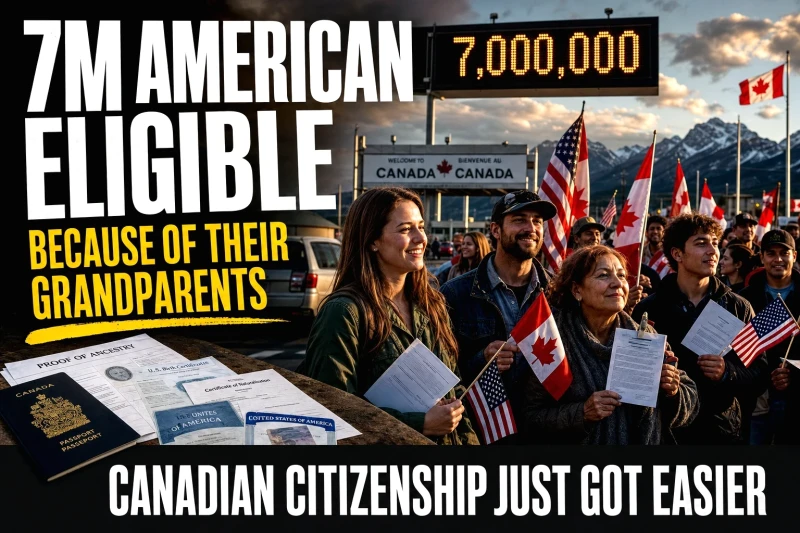
If you have a Canadian parent, grandparent, or great-grandparent, December 15, 2025 changed everything for you. Bill C-3 permanently eliminated the first-generation limit on Canadian citizenship by descent, instantly making between 4 to 7 million Americans eligible for Canadian citizenship. Unlike other countries that require years of residency or thousands in fees, Canada's process costs just $75 CAD and requires no physical presence. However, the application surge is creating significant delays - what IRCC quotes as 9-12 months is now tracking closer to 11+ months in reality. This guide breaks down exactly who qualifies under the new rules, the complete application process, and why processing times are lengthening despite official estimates.
🔑 Key Takeaways:
- Bill C-3 retroactively restored citizenship for millions born before December 15, 2025 with Canadian ancestry
- No residency requirement for those born before the cutoff date - citizenship may be automatic
- $75 CAD application fee makes this the world's cheapest second citizenship option
- Processing times extending beyond official 9-12 month estimates due to massive application surge
- Nearly 2,500 Americans applied in January 2026 alone - 10x more than any other country
The Game-Changing Moment That Created Millions of New Citizens
Sarah Martinez stared at her grandmother's old Canadian birth certificate from Saskatchewan, wondering if that faded document could actually change her family's future. Like millions of Americans, she had no idea that on December 15, 2025, a single piece of legislation would improve her from someone with "Canadian heritage" into someone with an automatic right to Canadian citizenship.
Bill C-3 didn't just modify Canada's citizenship laws - it obliterated the barriers that had prevented multiple generations from claiming their birthright. Immigration lawyers are calling it the most significant expansion of citizenship eligibility in Canadian history, and the numbers prove it: application volumes have exploded by over 3,000% in some provinces.
But here's what most people don't realize: if you were born before December 15, 2025, you might already be a Canadian citizen and just don't know it yet.
Who Qualifies Under the Revolutionary New Rules
The Automatic Eligibility Category (Born Before December 15, 2025)
If you were born before December 15, 2025, the eligibility rules are remarkably simple - and generous. Your Canadian citizenship may now be recognized automatically under Bill C-3, which retroactively restores citizenship for people who were previously excluded by the first-generation limit.
The key word here is "retroactively." This means the government recognizes that you should have been considered a Canadian citizen all along. No physical presence requirements. No substantial connection tests. No proving you've ever even visited Canada.
This applies to you if you have:
- Canadian parents (regardless of where they were born)
- Canadian grandparents (through your Canadian parent's restored citizenship)
- Canadian great-grandparents (if the lineage chain qualifies)
The New Requirements (Born On or After December 15, 2025)
For children born on or after December 15, 2025, Canada introduced what's known as the "1,095 days rule." Here's how it works:
Your Canadian parent must have spent at least 1,095 days (approximately 3 years) physically present in Canada before your birth. This only applies when your parent was also born outside Canada to a Canadian citizen - essentially, when you're the third generation born abroad.
The Grandparent Connection: How the Chain Actually Works
Here's where many people get confused, so let me break this down clearly:
You cannot skip generations. Citizenship doesn't jump directly from a Canadian grandparent to you if your parent isn't in the citizenship chain. However - and this is crucial - Bill C-3 may have retroactively restored your parent's Canadian citizenship, even if they never applied for it or didn't know they qualified.
Here's a real-world example: Your grandmother was born in Ontario in 1940. She moved to the United States, married an American, and had your father in 1965. Under the old rules, your father might have lost his claim to Canadian citizenship due to the first-generation limit. Under Bill C-3, your father's citizenship is now retroactively recognized. Once your father is confirmed as a Canadian citizen, you qualify as the child of a Canadian citizen.
This chain reaction effect is why immigration experts estimate that millions of Americans suddenly became eligible overnight.
Application Process: What You Actually Need to Do
Required Documents and Forms
The application centers around form CIT 0001 - Application for a Citizenship Certificate. Here's exactly what you need to gather:
| Document Type | Specific Requirements | Where to Obtain |
|---|---|---|
| Your birth certificate | Long-form/certified copy showing parents' names | Vital records office in your birth state/country |
| Canadian parent's proof of citizenship | Birth certificate, citizenship certificate, or passport | Provincial archives or previous applications |
| Physical presence evidence | Only for births after Dec 15, 2025 | Tax returns, school records, employment history |
| Photos | Two passport-style photos meeting IRCC specifications | Professional photo services |
| Government ID | Photocopy of current driver's license or passport | Current documents |
| Application fee | $75 CAD (approximately $55 USD) | Online payment or money order |
The Document Hunt: Where to Find Canadian Records
The surge in applications has overwhelmed provincial archives across Canada. Here's the current situation at major record-keeping offices:
| Province/Territory | Archive Office | Record Types Available | Current Wait Times |
|---|---|---|---|
| Quebec | Bibliothèque et Archives nationales du Québec | Birth, marriage, death certificates | 6-8 weeks (up from 1-2 weeks) |
| Ontario | ServiceOntario Archives | Birth certificates 1869-present | 4-6 weeks |
| British Columbia | BC Vital Statistics | Birth, marriage, death records | 5-7 weeks |
| New Brunswick | Provincial Archives | Vital records 1888-present | 3-5 weeks |
| Saskatchewan | Saskatchewan Archives | Birth certificates 1920-present | 4-6 weeks |
| Alberta | Alberta Government Services | Vital statistics records | 3-4 weeks |
💡 Pro tip: If you know the specific city or town where your Canadian ancestor was born, contact that municipality's clerk office first. They often have faster access to local records than provincial archives.
Processing Times: The Reality Behind Official Estimates
IRCC officially quotes 9 to 12 months for citizenship certificate applications, but here's what's actually happening on the ground:
Current Processing Reality (April 2026)
- Official estimate: 9-12 months
- Actual processing time: 11-14 months for applications filed in Q1 2026
- Current backlog: Nearly 48,000 people waiting for decisions
- Monthly trend: Processing times extending by 2-3 weeks each month
The bottleneck isn't just volume - it's verification. Each application requires IRCC officers to trace citizenship lineage through multiple generations, often involving records from different provinces and time periods. When your great-grandfather's 1923 birth certificate from rural Manitoba needs verification, it takes time.
The Application Surge: Numbers That Tell the Story
The data reveals just how massive this citizenship expansion has become:
Application Volume by Country (January 2026)
| Country of Origin | Applications Filed | Percentage of Total |
|---|---|---|
| United States | 2,487 | 68.5% |
| United Kingdom | 290 | 8.0% |
| Australia | 156 | 4.3% |
| Germany | 134 | 3.7% |
| France | 89 | 2.5% |
| Other countries | 474 | 13.0% |
Provincial Archive Request Increases
The numbers from provincial archives show the true scale of this citizenship rush:
| Province | Jan 2025 Requests | Jan 2026 Requests | Percentage Increase |
|---|---|---|---|
| Quebec | 32 | 1,089 | 3,303% |
| Ontario | 127 | 1,456 | 1,047% |
| British Columbia | 89 | 892 | 902% |
| New Brunswick | 23 | 234 | 917% |
| Saskatchewan | 18 | 167 | 828% |
Cost Comparison: Why Canada is the Bargain Option
When you compare citizenship by descent options globally, Canada stands out as remarkably affordable:
Global Citizenship Costs Comparison
| Country | Application Fee | Additional Costs | Total Typical Cost | Processing Time |
|---|---|---|---|---|
| Canada | $75 CAD ($55 USD) | Document fees: $50-150 | $200-400 USD | 11-14 months |
| Ireland | €278 ($300 USD) | Solicitor fees: $800-1,500 | $1,100-1,800 USD | 12-24 months |
| Italy | €300 ($325 USD) | Translation/apostille: $600-1,200 | $925-1,525 USD | 24-48 months |
| United Kingdom | £1,012 ($1,250 USD) | Legal fees: $500-1,000 | $1,750-2,250 USD | 6-12 months |
| Germany | €255 ($275 USD) | Documentation: $400-800 | $675-1,075 USD | 12-18 months |
The $75 CAD fee makes Canadian citizenship by descent the most affordable second passport option available anywhere in the world. Even with document retrieval costs, most applicants spend less than $400 total.
Comparison to Other Major Immigration Destinations
Ireland: The Traditional Grandparent Route
Ireland remains popular because of its straightforward grandparent rule - if you have an Irish-born grandparent, you can claim citizenship through the Foreign Births Register. However, the process has become increasingly backlogged, with wait times stretching 18-24 months in many cases.
The Irish route costs significantly more and requires extensive documentation going back multiple generations. For many Americans with both Irish and Canadian ancestry, the Canadian route is faster and cheaper.
United Kingdom: The First-Generation Wall
The UK maintains strict first-generation limits similar to what Canada just eliminated. British citizenship by descent only passes to the first generation born abroad, and only if the British parent was a citizen "otherwise than by descent" (meaning born in the UK or naturalized, not also claiming citizenship by descent).
This makes the UK route much more restrictive than Canada's new system.
Australia: The Residency Requirement Route
Australia doesn't offer citizenship by descent beyond the first generation. Instead, they require 4 years of lawful residence, with 12 months as a permanent resident, plus a citizenship test and AUD$560 in fees.
For Americans seeking second citizenship, Australia requires actually moving there - a much bigger commitment than Canada's document-based process.
Dual Citizenship: What This Means for Your Current Status
One of the biggest advantages of Canadian citizenship by descent is that Canada fully recognizes dual (and multiple) citizenship. You don't have to renounce your American citizenship or any other citizenship you currently hold.
Countries That Allow Dual Citizenship
| Country | Dual Citizenship Policy | Notes |
|---|---|---|
| Canada | Fully permitted | No restrictions on multiple citizenships |
| United States | Permitted but not encouraged | Must file taxes regardless of residence |
| United Kingdom | Fully permitted | Changed policy in 1949 |
| Australia | Permitted since 2002 | Previously required renunciation |
| Ireland | Fully permitted | EU citizenship benefits included |
| Germany | Limited acceptance | Strict conditions apply |
Countries That Prohibit Dual Citizenship
| Country | Policy | Requirement |
|---|---|---|
| Japan | Prohibited | Must choose by age 22 |
| China | Prohibited | Automatic loss of Chinese citizenship |
| India | Prohibited | Must renounce Indian citizenship |
| Singapore | Prohibited | Rare exceptions granted |
The Strategic Advantages of Canadian Citizenship
Beyond the relatively simple application process, Canadian citizenship offers several unique advantages:
Healthcare and Social Benefits
- Universal healthcare coverage in any province where you establish residency
- Access to Canadian Pension Plan (CPP) benefits
- Employment Insurance eligibility
- Child benefits and family allowances
Education Opportunities
- Domestic tuition rates at Canadian universities (often 60-70% less than international student fees)
- Access to Canadian student loan programs
- Eligibility for research grants and academic positions
Business and Investment Access
- No restrictions on business ownership or real estate investment
- Access to NAFTA/USMCA professional worker categories
- Eligibility for government contracts and security clearances
Travel and Mobility
- Visa-free travel to 185 countries on Canadian passport
- Consular protection from Canadian embassies worldwide
- Right to live and work anywhere in Canada without permits
Common Mistakes That Delay Applications
After reviewing hundreds of applications, immigration consultants have identified the most frequent errors that cause processing delays:
Documentation Errors
- Submitting short-form birth certificates: IRCC requires long-form certificates showing parents' names
- Missing apostilles: Foreign documents often need authentication
- Incomplete family tree documentation: Every link in the citizenship chain must be proven
Application Form Mistakes
- Inconsistent name spellings: Variations between documents cause verification delays
- Missing signatures or dates: Incomplete forms are automatically rejected
- Incorrect fee payments: Currency conversion errors or wrong payment methods
Timeline Confusion
- Applying under wrong rules: Born before vs. after December 15, 2025 have different requirements
- Misunderstanding physical presence requirements: Only applies to post-December 15, 2025 births
What Happens After You Apply
The IRCC Review Process
Once IRCC receives your application, here's what happens:
- Initial Review (Weeks 1-4): Completeness check and fee processing
- Document Verification (Months 2-6): Citizenship chain confirmation
- Background Checks (Months 4-8): Security and identity verification
- Final Decision (Months 8-14): Citizenship certificate production and mailing
Tracking Your Application
IRCC provides online tracking through the Client Application Status tool. You'll receive:
- Confirmation of receipt within 2-3 weeks
- Updates when your file moves between processing stages
- Request for additional documents if needed
- Final decision notification
If Your Application is Approved
Your citizenship certificate arrives by registered mail and serves as official proof of Canadian citizenship. With this document, you can:
- Apply for a Canadian passport
- Register to vote in Canadian elections
- Access all citizenship benefits and services
- Sponsor family members for Canadian immigration
Planning Your Next Steps
Immediate Actions to Take
If you believe you qualify for Canadian citizenship by descent:
- Gather family documents: Start with what you have - birth certificates, passports, family records
- Contact provincial archives: Request certified copies of Canadian ancestor records
- Organize your citizenship chain: Map out each generation from your Canadian ancestor to you
- Calculate processing time: Factor in 11-14 months from application submission
- Consider professional help: Complex cases benefit from immigration consultant review
Long-term Considerations
Tax Implications: Canadian citizens must file tax returns if they become Canadian tax residents. However, citizenship alone doesn't trigger tax obligations - residency does.
Military Service: Canada has no mandatory military service, so citizenship doesn't create service obligations.
Voting Rights: You can vote in Canadian federal elections immediately upon citizenship confirmation, regardless of residence.
The Bottom Line: A Historic Opportunity
Bill C-3 represents the largest expansion of citizenship eligibility in Canadian history. For the estimated 4-7 million Americans who suddenly qualify, this isn't just about getting a second passport - it's about accessing one of the world's most respected citizenships at a fraction of the cost and complexity of other options.
The application surge means processing times are lengthening, but the fundamentals remain incredibly favorable: no residency requirements, minimal fees, and retroactive recognition for multiple generations. If you have Canadian ancestry, the question isn't whether you should explore this opportunity - it's how quickly you can get your application in the queue.
The window isn't closing, but the processing times are getting longer each month. For families considering their long-term options in an uncertain world, Canadian citizenship by descent offers something rare: a straightforward path to a respected second citizenship that doesn't require uprooting your life or spending thousands of dollars.
Your Canadian ancestor's decision to leave Canada decades ago doesn't have to be permanent for your family. Thanks to Bill C-3, that connection to Canada can be restored with a simple application and a $75 fee.
