Canadian birth certificates and passports under unprecedented citizenship review
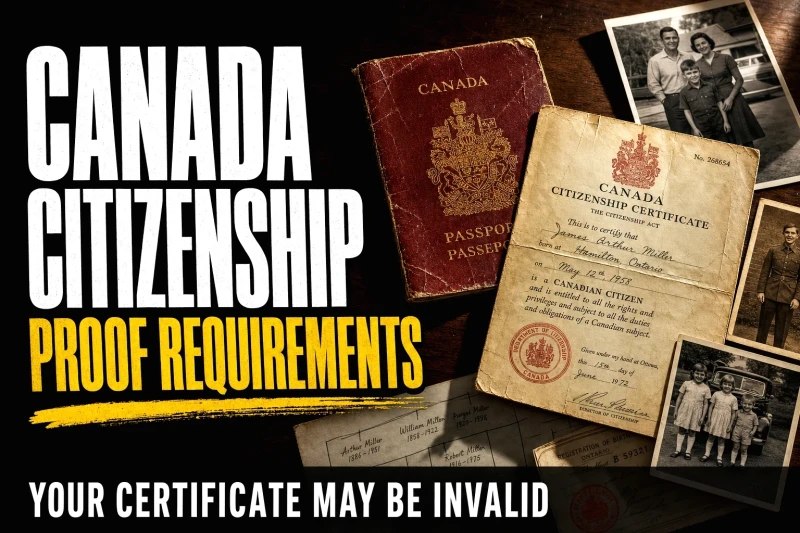
On This Page You Will Find:
- Why thousands of approved citizenship certificates are being suspended and what triggers the review process
- Which birth certificates and passports no longer meet Canada's proof-of-citizenship standards
- How the "Lost Canadians" law created an unexpected documentation crisis affecting 82,000 applicants
- Specific documentation requirements that can make or break your citizenship claim across generations
- What to do if you've already received (or applied for) a citizenship certificate based on Canadian ancestry
Summary:
If you're one of the thousands of Canadians who recently proved citizenship through a grandparent, you might be asked to return your certificate. Between December 2025 and March 2026, Immigration, Refugees and Citizenship Canada (IRCC) issued 4,075 citizenship certificates under new "Lost Canadians" rules—then abruptly suspended dozens (possibly hundreds) of them in June 2026, demanding recipients surrender their documents for review. The reason? IRCC now says genealogy websites and secondary records aren't enough, even if they were accepted months earlier. With processing backlogs exploding from 56,000 to 82,000 applications in just two months and wait times tripling from 5 to 15 months, the documentation standards you thought were sufficient when you applied may no longer be acceptable when your file reaches the front of the queue.
🔑 Key Takeaways:
- IRCC suspended citizenship certificates issued between December 2025 and March 2026, ordering recipients to return them for documentation review
- Birth certificates alone don't prove citizenship for those born outside Canada or born in Canada before 1947 to non-citizen parents
- Applications must now include "authentic, reliable, and verifiable documents" from original vital-statistics authorities for every generation—genealogy websites and third-party records are explicitly insufficient
- Processing backlogs jumped 46% in two months (from 56,000 to 82,000 applications), with wait times tripling from 5 to 15 months
- Even if you already received approval, your file may be re-evaluated against stricter standards than existed when you applied
When Your Canadian Birth Certificate Doesn't Mean You're Canadian
Sarah Martinez stared at the email in disbelief. Three months earlier, she'd received her Canadian citizenship certificate—official government confirmation that her grandmother's birth in Toronto made Sarah eligible for citizenship by descent. She'd already started her passport application. Now IRCC was demanding she return the certificate "pending further review" of her documentation.
She wasn't alone. In mid-June 2026, Immigration, Refugees and Citizenship Canada took an unprecedented step that sent shockwaves through the "Lost Canadians" community: the department suspended recently approved citizenship certificates and ordered an unknown number of recipients to return them.
Here's what's happening—and why documents you thought proved your Canadian citizenship might suddenly be worthless.
The "Lost Canadians" Law That Created This Crisis
On December 15, 2025, everything changed for people with Canadian grandparents. Bill C-3 eliminated the first-generation limit to citizenship by descent, which had previously restricted citizenship to children of Canadian citizens born abroad. Under the new rules, if you had at least one Canadian grandparent and were born before December 15, 2025, you could claim Canadian citizenship.
The response was overwhelming. Between December 15, 2025, and March 31, 2026—just three and a half months—IRCC issued 4,075 citizenship certificates under the new law.
Bill C-3 Citizenship Certificates Issued (Dec 15, 2025 - Mar 31, 2026):
| Category | Number of Certificates | Percentage |
|---|---|---|
| Total certificates issued | 4,075 | 100% |
| Applicants born in United States | ~1,955 | ~48% |
| Applicants born in other countries | ~2,120 | ~52% |
Nearly half went to applicants born in the United States—people who'd discovered a Canadian grandparent entitled them to dual citizenship.
Then, without warning, the suspensions began.
The Email That Changed Everything
Between June 13-15, 2026, IRCC sent notices to an undisclosed number of people who'd successfully obtained citizenship certificates based on Canadian ancestry. The message was stark: return your certificate immediately for review.
The letters didn't provide detailed explanations. Instead, they cited vague concerns about "documentation not being from original source authorities" or insufficient explanation of "why original source documents couldn't be obtained and the efforts made to obtain them."
Translation? The genealogy records, family documents, and secondary evidence that IRCC had accepted months earlier were suddenly inadequate.
Immigration Minister Lena Metlege Diab made the government's position clear: "Canadian ancestry does not guarantee Canadian citizenship. You must definitively prove your link to Canada at each and every generation. Genealogy websites are not enough."
What Documents IRCC Now Requires (And Why Yours Might Fail)
The June 2026 version of the CIT 0014 Document Checklist introduced several clarifications that fundamentally tightened documentary standards. If you're applying now—or if your application is still pending—here's what you need to understand:
Your application must be supported by authentic, reliable, and verifiable documents for every generation. That means:
- Original vital-statistics records from government authorities (birth certificates, marriage certificates, death certificates issued by provincial or territorial registrars)
- If original records are unavailable, you must provide a detailed explanation of why they can't be obtained and document all efforts you made to get them
- Third-party records alone are insufficient—this explicitly includes genealogy websites, family trees, church records, and similar sources
- Each generation must be proven independently—you can't skip a generation or rely on assumptions
The problem? Many people who applied between December 2025 and March 2026 used exactly the kinds of secondary evidence IRCC now rejects. They followed the guidelines that existed when they applied, only to have the rules change while their applications were being processed.
Even worse, some people who already received approval are being retroactively evaluated against the new, stricter standard.
The Birth Certificate Loophole That Catches Thousands
Here's something that surprises most people: being born in Canada doesn't automatically make you a Canadian citizen.
If your parent was working in Canada with diplomatic privileges for a foreign government or international organization when you were born, you weren't a Canadian citizen at birth—even though you have a Canadian birth certificate.
IRCC explicitly states: "While children born in Canada of accredited foreign representatives may obtain a birth certificate, this document does not confer any rights to citizenship and must not be used for procuring a Canadian passport. A birth certificate is simply meant to provide evidence of the birth in Canada."
This creates a trap for people applying for citizenship by descent. If you're trying to prove your parent or grandparent was Canadian, and they were born in Canada to a diplomat, their Canadian birth certificate doesn't prove citizenship—which breaks the chain for your own claim.
Similarly, if you were born in Canada before 1947 (when Canadian citizenship was first created as distinct from British subject status), your birth certificate alone doesn't prove citizenship without additional documentation showing your parents' status.
The Processing Backlog Explosion
The documentary crisis is colliding with a processing nightmare. As of June 10, 2026, 82,000 people were waiting for citizenship certificate applications to be processed—a staggering increase that happened in just two months.
Citizenship Certificate Application Backlog Growth:
| Date | Pending Applications | Monthly Increase | Processing Time |
|---|---|---|---|
| April 2026 | 56,000 | — | — |
| May 2026 | 70,400 | +14,400 | 5 months |
| June 10, 2026 | 82,000 | +11,600 | 15 months |
| Total increase (2 months) | +26,000 | +46% | +200% |
Processing times spiked from five months in May 2025 to 15 months as of June 2026—a 200% increase. If you're applying now, you're looking at a year and a quarter before you get an answer, assuming processing times don't continue climbing.
And here's the kicker: applicants who submitted applications before the June 2026 CIT 0014 update may find their files evaluated against a stricter standard than what was in place when they applied. You followed the rules, submitted acceptable documentation, and waited months—only to be told your evidence no longer meets the requirements.
The Whiplash: Some Certificates Reinstated
In a twist that highlights the chaos, just one week after demanding some "Lost Canadians" surrender their new citizenship certificates, IRCC reversed course for a few dozen people. Over the weekend following the initial suspension notices, some recipients received letters confirming their citizenship claims were valid once again.
IRCC confirmed it sent letters to "a few dozen" people demanding certificate surrender, then reinstated some of them. The department stated it has "temporarily paused the finalization of some new citizenship by descent applications" while conducting an internal review.
If you're caught in this limbo, you have no idea whether your certificate will be permanently revoked, temporarily suspended, or ultimately confirmed. The uncertainty is paralyzing for people who've made life decisions based on their citizenship status—accepting job offers in Canada, enrolling children in schools, or relocating families.
What Actually Proves Canadian Citizenship (And What Doesn't)
Let's cut through the confusion. Here's what does and doesn't prove Canadian citizenship under current IRCC standards:
✅ Documents That Prove Citizenship:
- Citizenship certificate issued by IRCC (if not suspended or revoked)
- Canadian passport (but only if the underlying citizenship claim was valid)
- Birth certificate showing birth in Canada after 1947 to at least one Canadian citizen parent (with proof of parent's citizenship)
❌ Documents That DON'T Prove Citizenship Alone:
- Birth certificate if you were born outside Canada
- Birth certificate if you were born in Canada before 1947 without proof of parents' status
- Birth certificate if you were born in Canada to a parent with diplomatic privileges
- Genealogy website records or family trees
- Previously issued passports (if the original citizenship claim is now questioned)
- Church records, census records, or other third-party documentation without government vital statistics
The critical rule: If you're claiming citizenship by descent (through a Canadian parent or grandparent), you must first apply to IRCC for proof of citizenship. If successful, you'll be granted a citizenship certificate, which you can then use to apply for a Canadian passport.
You cannot skip the citizenship certificate and go straight to a passport application if you were born outside Canada or if your citizenship claim depends on proving a parent or grandparent's status.
Who's Most at Risk Right Now
Based on the suspension patterns and IRCC's stated concerns, certain groups face higher scrutiny:
1. Second-generation descent applicants (citizenship through grandparents): If your claim depends on proving your grandparent was Canadian, you're tracing citizenship through two generations, which doubles the documentation requirements and potential weak points.
2. Applicants who used genealogy websites or secondary sources: If Ancestry.com, FamilySearch, or similar platforms provided your primary evidence for any generation, expect additional scrutiny or rejection.
3. People whose Canadian ancestor was born before 1947: Pre-1947 citizenship is more complex to prove because Canadian citizenship didn't exist as a distinct legal status—you need to demonstrate British subject status and connection to Canada.
4. Applicants with ancestors from provinces with poor historical record-keeping: If your grandparent was born in a province or territory with incomplete vital statistics records from that era, obtaining original source documents may be impossible—and IRCC's willingness to accept alternative evidence is now uncertain.
5. Anyone who received a certificate between December 2025 and March 2026: You're in the cohort IRCC is actively reviewing, even if you haven't received a suspension notice yet.
The Two-Tier Documentation System
Here's the bitter irony: recent immigrants with digitally-issued certificates navigate citizenship processes more smoothly than multi-generation Canadians relying on paper records their grandparents obtained.
If you became a Canadian citizen through naturalization in 2015, you have a modern citizenship certificate with digital records, barcodes, and verification systems. Your documentation is bulletproof.
But if your grandmother was born in a small Ontario town in 1935, her birth certificate—if you can even obtain it—is a piece of paper from a pre-digital era. The registrar's office might have burned down. The records might have been lost. The handwriting might be illegible. And now IRCC is telling you that's your problem to solve, not theirs.
The people with the longest, deepest Canadian roots are being asked to meet higher documentary standards than people who became Canadian last year.
What to Do If You're Affected
If you've received a suspension notice:
-
Don't panic, but don't ignore it. IRCC has given you a deadline to respond—missing it could result in permanent revocation.
-
Gather original vital statistics records immediately. Contact provincial or territorial vital statistics offices for certified copies of birth, marriage, and death certificates for every generation in your citizenship claim.
-
Document your efforts. If original records are unavailable, keep detailed records of every office you contacted, every request you made, and every explanation you received for why records can't be provided.
-
Consider immigration legal assistance. The stakes are high enough that professional help may be worth the investment, especially if your documentation situation is complex.
If you're planning to apply:
-
Start with original source documents. Don't rely on genealogy websites or family documents as your primary evidence—use them only to identify what original records you need to request.
-
Apply for vital statistics records from government authorities first. Get certified copies of birth certificates, marriage certificates, and any other relevant documents from provincial or territorial registrars before you submit your citizenship application.
-
Expect 15+ month processing times. Don't make irreversible life decisions based on an anticipated approval timeline.
-
Keep copies of everything. The documentary standard may change again while your application is pending—having comprehensive records of what you submitted and when will be crucial if you need to appeal.
The Bigger Question: What Happens Next?
IRCC's internal review is ongoing, and the department hasn't announced when it will conclude or what changes might result. In the meantime, 82,000 people are in limbo, with that number growing by thousands each week.
The fundamental tension is this: Canada wants to welcome "Lost Canadians" who were unfairly excluded by previous citizenship laws, but it also wants to prevent citizenship fraud and ensure documentary integrity. Those are legitimate, competing interests.
But the current approach—accepting applications under one standard, then suspending approvals when evaluated under a different standard—creates chaos and undermines trust in the system.
If you have Canadian ancestry and you're considering applying for citizenship by descent, understand that you're entering an uncertain process. The documentation you submit today may be evaluated against standards that don't exist yet. The approval you receive tomorrow may be suspended next month.
That doesn't mean you shouldn't apply—for many people, Canadian citizenship by descent offers tremendous benefits and opportunities. But go in with your eyes open, your documentation airtight, and your expectations realistic.
The government holds all the cards. Your job is to build the strongest possible documentary case, then wait to see which rules they'll apply when they finally get to your file.
